

Many patients ask me, “Are digital dental X-rays safe?” or “How often do I really need them?” As a sedation and general dentist in Boston, I want to put your mind at ease with science-backed facts and practical answers.
Thanks to digital dental X-rays, we can now detect issues earlier than ever—with up to 90% less radiation than traditional film. And when used properly, they’re one of the safest tools in healthcare.
Let’s take a closer look at when X-rays are necessary, how they compare to everyday radiation, and what safety measures are in place—especially for children and pregnant patients.
🧪 Why Are Dental X-Rays Needed?
Dental X-rays help us see what the naked eye can’t:
- Cavities between teeth
- Hidden tooth infections or abscesses
- Bone loss from gum disease
- Developing teeth in kids
- Wisdom tooth positioning
- Impacted teeth or roots
- Bone structure for dental implants
Without them, we’d miss many issues until they become painful or expensive to treat. X-rays give us an early warning system—and peace of mind.
How Safe Are Digital Dental X-Rays?
Very safe. Digital dental X-rays cut radiation exposure by 80–90% compared to older film systems.
Radiation Comparisons (for perspective):
- Single dental X-ray: 0.005 mSv – about 1 day of background radiation
- Four bitewings: 5 μSv – less than a coast-to-coast flight
- Panoramic scan: 10–20 μSv – about 2-3 days of natural exposure
- Chest X-ray: 100 μSv – 20x more than dental X-rays
- Eating a banana: 0.1 μSv (yes, bananas are slightly radioactive!)
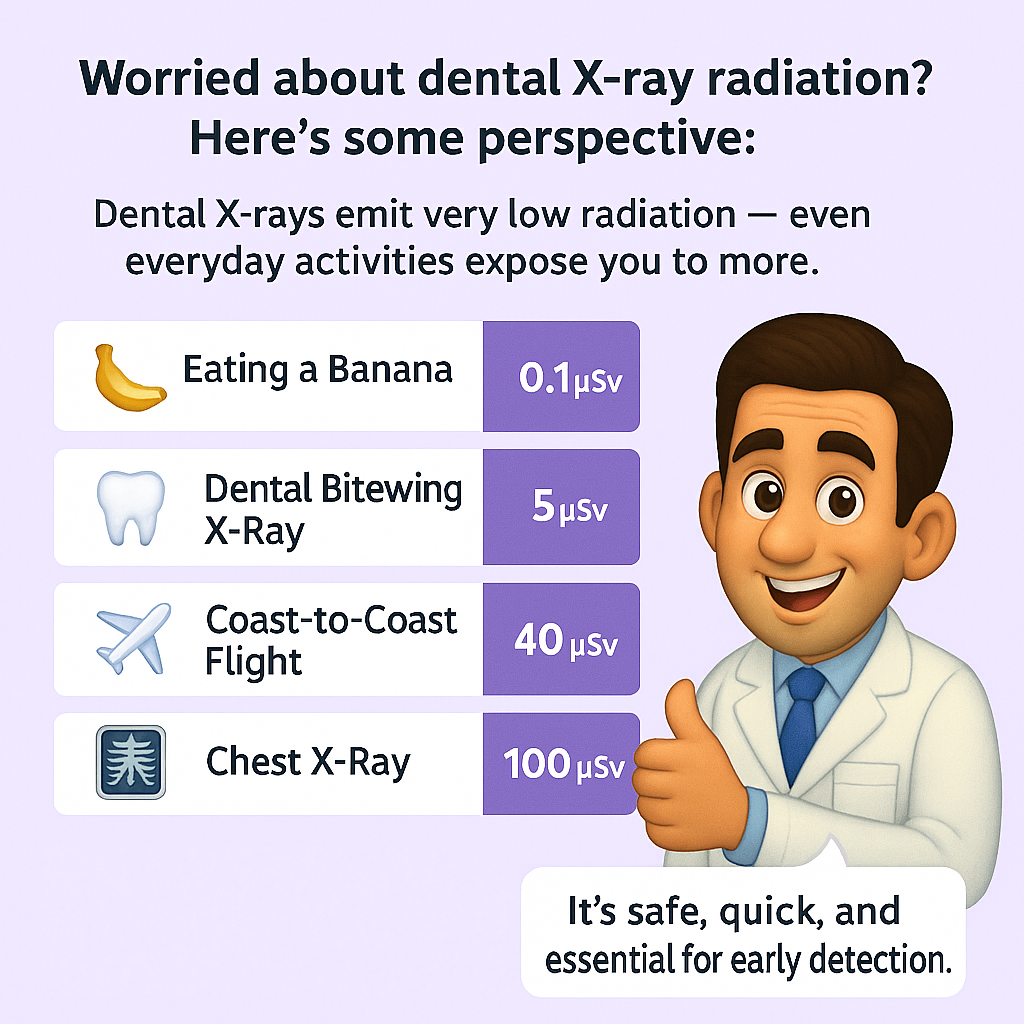
➡️ Bottom line: Dental X-rays expose you to less radiation than your daily environment.
🗓️ How Often Should I Get Dental X-Rays?
There’s no one-size-fits-all answer. At Aesthetic Smile Reconstruction, we tailor X-ray schedules to each patient’s needs.
Adult X-Ray Schedule (General Guidelines):
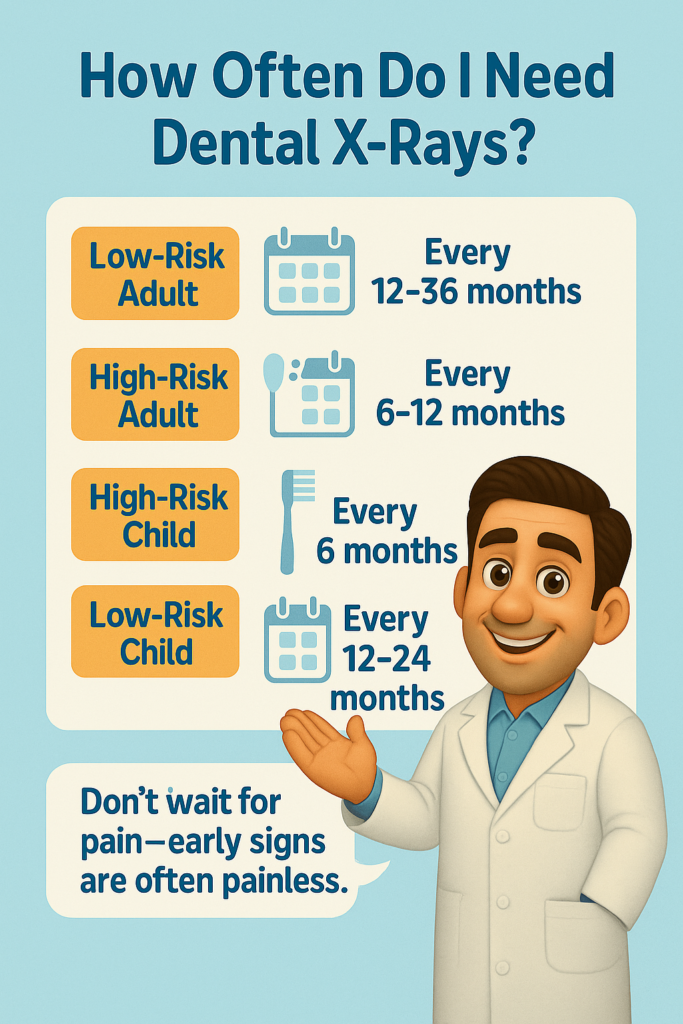
- Bitewing X-rays (for cavities): Every 12–36 months if you’re low risk
- Full-mouth series: Every 3–5 years for healthy patients
- Panoramic X-rays: As needed for wisdom teeth, TMJ issues, or implant planning
👉 Patients with higher risk (frequent decay, gum disease, dental work) may need X-rays more often.
Kids and Teens:
- First X-rays: Usually by age 4–5 (when back molars start touching)
- High-risk kids: Every 6 months
- Low-risk kids: Every 12–24 months
X-rays help us monitor tooth development and catch decay early—especially since children’s enamel is thinner and decay can progress faster.
Can Pregnant Women Get Dental X-Rays?
Yes—dental X-rays are safe during pregnancy, especially when we use digital imaging and follow standard precautions.
Key Facts:
- Fetal exposure from a dental X-ray: 0.009 to 7.97 μSv
- Harm threshold: Over 50,000 μSv (dental X-rays are 10,000x lower)
- Emergency X-rays: Safe in any trimester when medically necessary
- Routine X-rays: Often delayed until 2nd trimester for comfort
We also use shielding and beam restriction to protect both mom and baby. Talk to your OB-GYN if you have questions—we’re happy to coordinate care.
Do I Still Need a Lead Apron?
Here’s what’s new: the ADA updated its guidelines in 2024, stating that lead aprons and thyroid collars are no longer routinely necessary for digital dental X-rays.
Why?
- Modern digital machines use focused beams and very low radiation
- Beam collimation limits exposure to targeted areas
- Aprons can interfere with imaging if misused
That said, we’re happy to use protective coverings if it gives you peace of mind—especially during pregnancy.
What Is the ALARA Principle?
We follow the ALARA principle: “As Low As Reasonably Achievable.”
That means:
- We only take X-rays when they’re clinically necessary
- We customize frequency based on your needs
- We use digital imaging to reduce dose
- We keep records to avoid taking unnecessary X-rays
Your safety always comes first.
What Types of Dental X-Rays Are There?
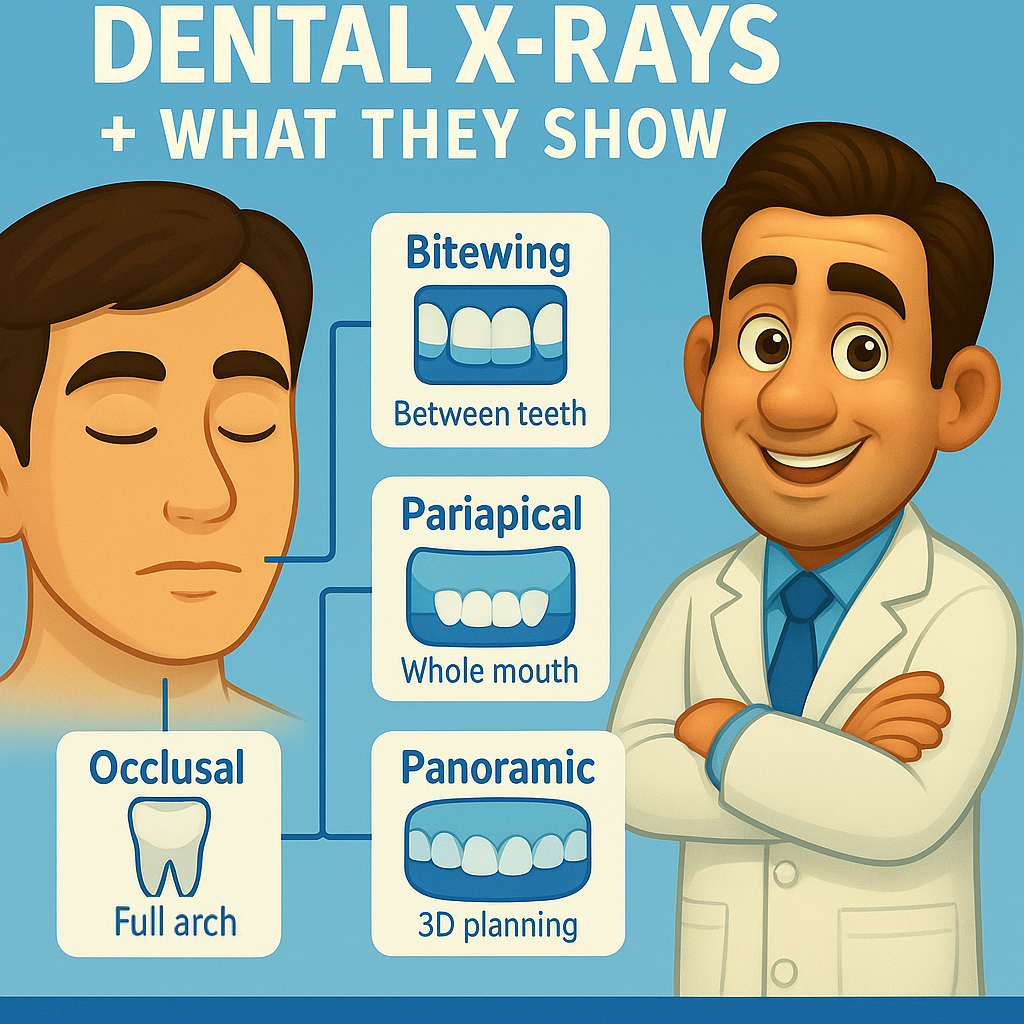
Each type of X-ray serves a specific purpose:
- Bitewings: Detect cavities between teeth
- Periapical: Show root structure and bone support
- Panoramic: Capture the full mouth, jaw, and sinuses
- Occlusal: Show full arch in children or to detect cysts and growths
- Cone Beam CT: 3D scans used in implant and surgical planning
🧠 Patient Story: When Digital X-Rays Caught the Unexpected
Emma, a 32-year-old patient from Boston, came in for a routine cleaning. She hadn’t had X-rays in three years. Though everything looked fine during her exam, her bitewing X-rays revealed a cavity hidden between two back molars.
Thanks to early detection, we treated it with a simple filling—saving her time, money, and discomfort.
X-rays often reveal what we can’t see or feel until it’s too late.
❓ FAQs About Dental X-Ray Safety & Frequency
Are dental X-rays safe for kids?
Yes. Digital dental X-rays are low-dose and safe for children when taken only as needed. We follow pediatric guidelines to limit frequency.
Can I refuse dental X-rays?
You can—but without X-rays, we may miss important problems. It’s best to discuss your concerns so we can make an informed decision together.
Why do some people need X-rays more often?
Frequent decay, gum issues, crowns, or a history of dental problems increase risk. We adjust your schedule based on your health.
Are dental X-rays safer than other imaging tests?
Yes. A dental bitewing X-ray is about 1/20th the dose of a chest X-ray and far less than a CT scan.
Is there any long-term risk from dental X-rays?
Not when done properly. The risk of missing dental disease far outweighs the extremely low radiation dose from modern X-rays.
Why do I need X-rays if I have no pain?
Many dental issues are invisible and painless in early stages. X-rays help us catch problems before they require more invasive treatment.
What if I’ve had many X-rays before?
Even with a full history of dental X-rays, the accumulated radiation exposure remains extremely low. We track your X-rays and only take new ones when necessary.
How do digital dental X-rays reduce radiation?
They use electronic sensors instead of film, which require less exposure. This results in faster, clearer images with lower radiation.
Do dental insurance plans cover X-rays?
Yes. Most dental plans cover bitewings once per year and full series every 3-5 years. Coverage varies, so we help you confirm benefits.
Can X-rays detect oral cancer or jawbone loss?
Yes. Panoramic and periapical X-rays help detect cysts, tumors, and bone deterioration—often before you feel any symptoms.
📍 Boston’s Trusted Low-Dose Dental X-Rays
If you’re looking for safe, modern dental X-rays in Boston, Aesthetic Smile Reconstruction is here to help. We use state-of-the-art digital imaging to give you the answers you need with minimal radiation.
Schedule your exam and X-rays →consultation with Dr. Sutera today.
💬 Still have questions?
Drop them in the comments—we’re happy to answer. Or bring them to your next visit.
🔔 Subscribe to my YouTube Channel for trusted answers to your biggest dental questions — from cleanings to smile makeovers.
