

Last Updated: May 15, 2026 | Next Review: November 15, 2026
Written by: Dr. Charles Sutera, DMD, FAGD
Botox for temporomandibular joint disorder (TMJ) is not FDA-approved. It is used off-label, meaning the FDA has not formally evaluated it for safety or efficacy in the masticatory muscles [1]. Most patients are never told this. They should be.
A nightguard is not a substitute for Botox, and Botox is not a substitute for a nightguard. They address different problems. Choosing between them — or deciding to use both — should be driven by what is actually causing your symptoms, not by what your dentist happens to offer.
This post explains the honest decision framework: what each treatment does, when each one is appropriate, what they cost over time, and what the published research actually shows. For the broader clinical context, see Will My TMJ Ever Go Away? A Clinical Decision Framework.
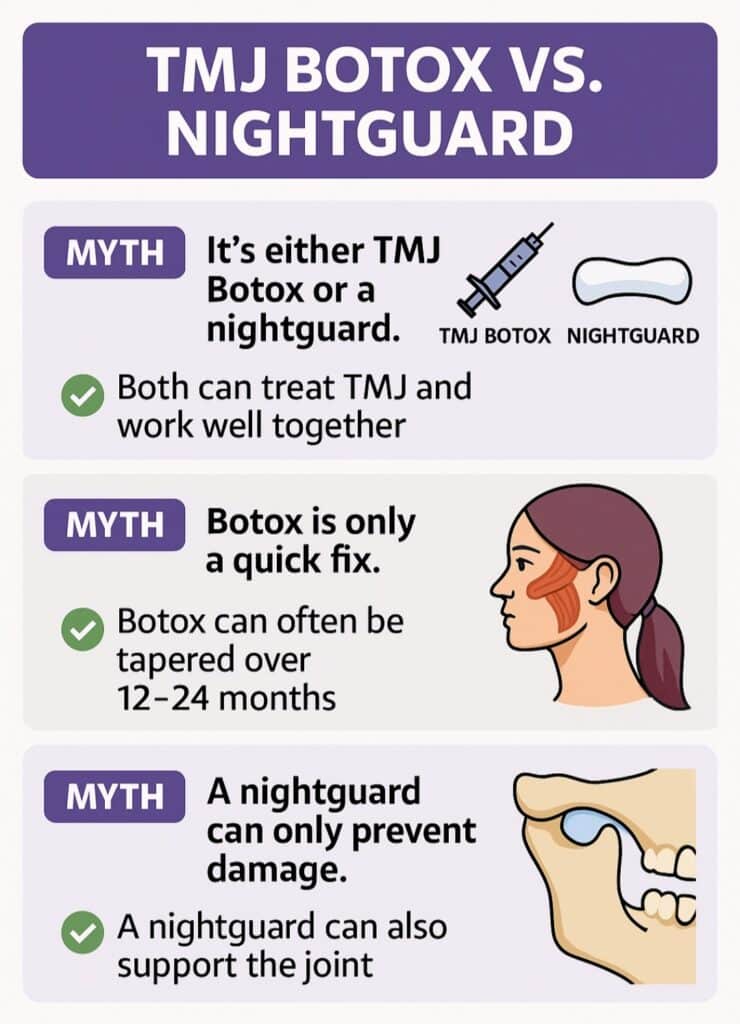
What is the difference between Botox for TMJ and a nightguard?
Botox reduces muscle force. A nightguard protects the teeth and stabilizes the bite. That is the entire distinction, and it explains why these are not interchangeable treatments.
Botulinum toxin type A blocks the nerve signals that tell muscles to contract. Injected into the masseter and temporalis muscles, it reduces the force a patient can generate during clenching and grinding by 30 to 50 percent. Onset is 3 to 7 days. Peak effect is at 2 weeks. Duration is 3 to 4 months, after which the muscle returns to its prior activity level [2].
A nightguard is a custom-fabricated dental appliance worn during sleep. It does three things Botox cannot do. It puts a physical barrier between the upper and lower teeth, preventing wear from grinding. It distributes the load of clenching across all teeth instead of concentrating force on a few. And for some patients, it repositions the jaw to reduce strain on the joint itself.
I tell patients this directly. Botox addresses the muscle. A nightguard addresses the teeth and the bite. Neither one addresses the underlying reason a patient is clenching in the first place — that requires a separate diagnostic process.
Is Botox for TMJ FDA-approved?
No. The FDA has approved botulinum toxin type A for cosmetic use, chronic migraine, and several muscle spasticity conditions. It has not approved its use for TMJ disorders or masticatory muscle injection [1][3].
This is not the same as unapproved or unsafe. Off-label prescribing is legal and common across medicine. Roughly one in five prescriptions in the United States is off-label. What it means in practice is that the FDA has not formally evaluated Botox in the masticatory muscles for safety or efficacy at the dosing levels used for TMJ, and insurance rarely covers it.
Patients should know this for three reasons. First, it affects cost — you will almost certainly pay out of pocket. Second, it affects how research is interpreted, because the studies supporting Botox for TMJ are smaller and more variable than the studies supporting its FDA-approved uses. Third, it shapes the question of long-term safety, which has not been fully resolved.
Most practices do not lead with this information because it complicates the conversion. Patients deserve to make this decision with full information.
Which one should I try first?
The first-line treatment for TMJ in nearly all cases is conservative care plus a custom nightguard. This is consistent with the American Academy of Orofacial Pain and AAOMS treatment hierarchy, which both place reversible, non-pharmacological interventions before injections and surgery [4].
The decision changes based on what is driving symptoms.
Start with a nightguard if: You have nighttime grinding or clenching, visible tooth wear, joint clicking or locking, or symptoms that are worse in the morning. A custom nightguard addresses all four. It is reversible, evidence-supported, and far less expensive than ongoing Botox.
Consider Botox as an addition if: You have severe muscle pain or visible masseter hypertrophy, tension headaches at the temples, or pain that persists despite consistent nightguard use. In these cases, Botox can reduce the force feeding the muscle pattern while the nightguard handles structural protection.
Botox may be the right first step if: You cannot tolerate a nightguard for medical or sensory reasons, you have failed multiple appliance trials, or your dental anxiety is so severe that the appliance-fitting process itself is a barrier to care. For these patients, sedation dentistry combined with Botox can serve as a bridge until comprehensive treatment is possible. See Sedation Dentistry for Dental Anxiety.
Neither one is the right first step if: Your TMJ is driven by significant bite misalignment, disc displacement, or arthritis. In these cases, both Botox and a generic nightguard treat the surface presentation while the underlying mechanical problem progresses. Diagnostic imaging and bite analysis come first.
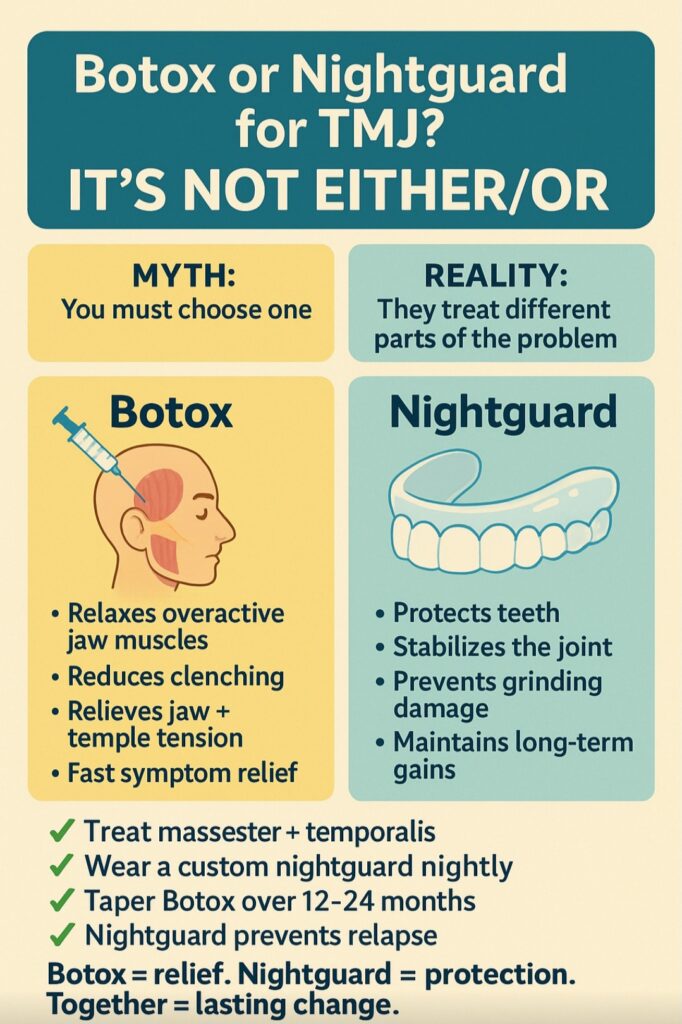

When does combining Botox and a nightguard make sense?
Combination therapy makes sense when a patient has severe muscle-pattern TMJ that has not responded fully to a nightguard alone, and when the muscle pain itself is the primary obstacle to function and sleep.
In my practice, combination therapy typically follows this sequence. The patient starts with a custom nightguard and 4 to 6 weeks of conservative care — soft diet, anti-inflammatories, behavioral modification. If muscle pain remains significant at the 6-week mark, Botox is added to reduce the force driving the pattern. Most patients in this category see meaningful improvement within 2 to 3 weeks of the first injection, with peak benefit at 4 to 6 weeks.
Combination therapy is not the right approach for everyone. Patients with mild symptoms responding to nightguard alone do not benefit from added Botox. Patients with joint-pattern TMJ need different treatment entirely. The decision to combine is based on response to first-line care, not on a fixed protocol.
How much does Botox for TMJ cost compared to a nightguard?
The cost difference over time is significant. Patients should understand the full picture before committing.
Botox for TMJ: Typical pricing is $500 to $1,500 per treatment session, depending on dosing and geography. Standard dosing involves 20 to 30 units per masseter and 10 to 20 units per temporalis, repeated every 3 to 4 months. Annual cost: $2,000 to $6,000. Insurance rarely covers it because of the off-label status. Patients can request CPT code 64612 for claim submission, but coverage is inconsistent.
Custom nightguard: One-time cost of $500 to $1,200 from a dentist. Lifespan is typically 5 to 10 years with proper care. Some dental insurance plans cover a portion. Over-the-counter mouth guards from pharmacies cost $20 to $50 but do not provide the bite-stabilization function of a custom appliance and can sometimes worsen symptoms.
Over 5 years: A patient using Botox alone spends $10,000 to $30,000. A patient using a single custom nightguard spends $500 to $1,200. Combined therapy falls between these, depending on how frequently Botox is needed.
The cost comparison matters because some practices recommend ongoing Botox as a standalone solution without explaining the long-term financial picture. Patients deserve to weigh that math before committing.
What does the research say about Botox for TMJ?
The research is real but limited and mixed. Patients should know what the evidence actually shows, not the marketing summary.
Pain reduction: Published studies have shown 32 to 45 percent reduction in pain scores following Botox injections to the masseter and temporalis muscles [5]. A 2024 meta-analysis found Botox more effective than placebo for myofascial TMJ pain, but not superior to standard conservative treatments.
Jaw function: Studies have not shown significant improvement in mouth opening compared to placebo or conventional therapies. Botox helps with pain and muscle force, not with mechanical function of the joint.
Long-term safety: This is where the evidence is genuinely contested. Animal studies have consistently shown bone density changes in the mandible following repeated masseter injections — a phenomenon called disuse osteopenia, caused by reduced mechanical loading on the bone [6]. Human studies are less conclusive. A 2020 study found reduced trabecular bone density in the mandibular condyle of TMJ patients who had received two or more Botox treatments [7]. A 12-month randomized controlled trial published more recently found no clinically significant effect on mandibular bone density in healthy adults receiving repeat treatments [8].
The honest reading is that short-term safety at therapeutic doses is well-established. Long-term safety with repeated injections over many years is still being studied. Patients planning to use Botox for TMJ indefinitely should understand this.
What Botox does not fix
Botox masks the muscle pattern. It does not stop the grinding behavior, correct a misaligned bite, address sleep apnea, or repair a damaged joint. Each of these requires its own treatment.
Grinding behavior continues. Patients on Botox grind less forcefully, but the parafunctional habit is still present. When the Botox wears off, the muscle returns to its prior activity level. Without behavioral and protective intervention, the pattern resumes.
Bite misalignment continues. If the underlying cause of muscle overactivity is a bite that doesn’t meet correctly, Botox does nothing to correct it. The joint continues to be loaded incorrectly with every chew.
Sleep apnea continues. A subset of TMJ patients are clenching at night as a compensatory response to airway obstruction. Treating the muscle without screening for sleep apnea addresses the symptom and misses the cause.
Joint pathology continues. Disc displacement, arthritis, and structural damage to the joint itself are not affected by Botox. Patients with joint-pattern TMJ who use Botox alone often feel symptomatic improvement while the underlying joint condition progresses unrecognized.
This is the conversation patients deserve to have before starting any treatment. Botox can be useful. It is rarely the complete answer.
Your next step
If you are deciding between Botox and a nightguard for TMJ, the right answer depends on what is driving your symptoms. A patient with muscle hypertrophy and tension headaches will benefit from a different treatment plan than a patient with joint clicking and bite issues.
For a diagnostic evaluation that identifies what is actually causing your TMJ and matches treatment to category, schedule a consultation with our team at Aesthetic Smile Reconstruction. We serve Waltham, Newton, Brookline, Wellesley, Weston, Lexington, Cambridge, and Greater Boston.
Schedule a consultation | Smile transformations | Dr. Sutera on LinkedIn
References
-
The TMJ Association. Patient Bone-Related Safety of Botox for Treatment of TMJ Disorders. https://tmj.org/patient-bone-related-safety-of-botox-for-treatment-of-tmj-disorders/
-
Raphael KG, Janal MN, Tadinada A, et al. Effect of multiple injections of botulinum toxin into painful masticatory muscles on bone density in the temporomandibular complex. Journal of Oral Rehabilitation. 2020. https://onlinelibrary.wiley.com/doi/10.1111/joor.13087
-
Weill Medical College of Cornell University. Botulinum Toxin Versus Placebo Injections to Temporalis and Masseter Muscles. ClinicalTrials.gov. https://clinicaltrials.gov/study/NCT03223298
-
Conservative vs Invasive Interventions for Temporomandibular Disorders — Executive Summary of the Clinical Practice Guideline. 2025. https://www.tandfonline.com/doi/full/10.1080/19424396.2025.2588942
-
Botulinum Toxin Versus Placebo Injections — Study Protocol and Pain Score Data. https://cdn.clinicaltrials.gov/large-docs/98/NCT03223298/Prot_SAP_000.pdf
-
Botulinum toxin in masticatory muscles: Short- and long-term effects on muscle, bone, and craniofacial function in adult rabbits. NCBI / PMC. https://pmc.ncbi.nlm.nih.gov/articles/PMC3278508/
-
Effect of multiple injections of botulinum toxin into painful masticatory muscles on bone density in the temporomandibular complex (PMC version). https://pmc.ncbi.nlm.nih.gov/articles/PMC7693250/
-
Longitudinal Computed Tomography Indicates No Negative Impact of OnabotulinumtoxinA on Mandibular Bone Density in a 12-Month, Double-Blind, Randomized, Repeat Treatment, Placebo-Controlled Study. https://www.ncbi.nlm.nih.gov/pmc/articles/PMC12706864/
Medical disclaimer. This article provides general educational information and is not a substitute for professional dental or medical advice. Botox for TMJ is an off-label use of botulinum toxin type A. Individual needs vary. Schedule a consultation for personalized recommendations.
