
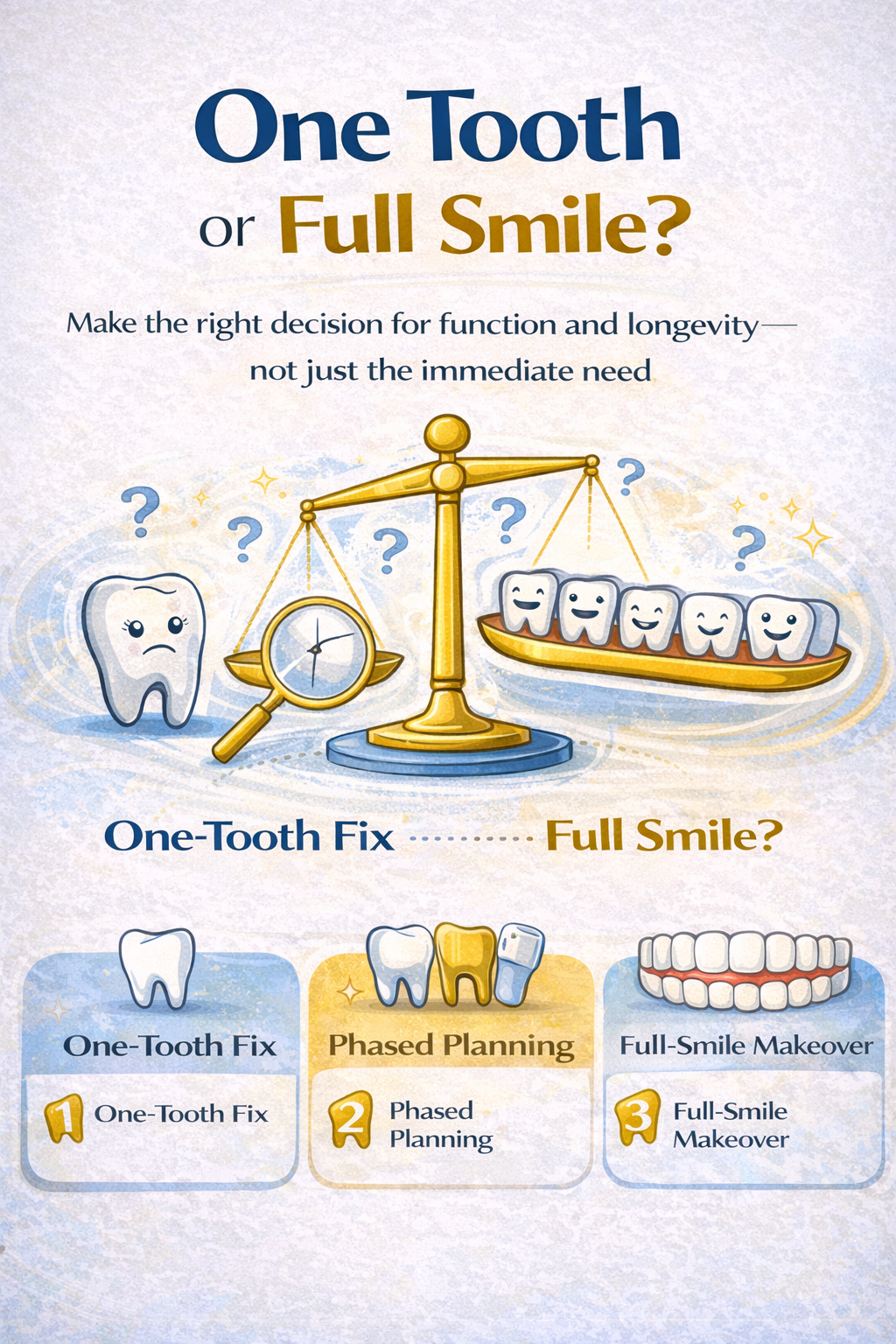
One of the most common questions I hear in my Boston practice is, “Should I fix one tooth or my whole smile?” Patients point to a single chipped, discolored, or bothersome tooth and wonder if that’s all they need, or if they’re looking at a bigger project. That moment of uncertainty is completely normal. When considering whether to fix one tooth or a whole smile, it’s important to understand that this isn’t a sales decision; it’s a clinical one based on how your teeth work together as a system.
In our practice, we see patients daily who are trying to decide whether to fix one tooth or address their entire smile. The answer doesn’t come from a brochure or what’s trending. It comes from a careful evaluation of your bite, your dental history, and your long-term oral health. Dentists don’t decide treatment scope based on how many teeth you want to fix. They decide based on how your teeth function together.
Let me walk you through exactly how we make this determination, so you can feel confident in whatever path you choose.
✅ What You’ll Learn About Treatment Scope
-
The clinical reasons to fix one tooth versus a whole smile
-
How we determine if a single tooth repair is sufficient or if a full smile makeover is needed
-
Why fixing one tooth in isolation can sometimes create new problems
-
How to have an informed conversation about cosmetic dentistry scope
When Fixing One Tooth Is the Right Choice

Conservative dentistry is often the best dentistry. There are clear situations where I recommend we only fix the one tooth that’s bothering you. This approach makes sense when:
-
The Problem Is Isolated: Think trauma from an accident or a small chip on an otherwise healthy tooth.
-
Your Bite Is Stable: No signs of clenching, grinding, or uneven wear patterns.
-
Aesthetic Matching Is Predictable: The surrounding teeth are healthy and a seamless color/match can be achieved.
-
No Functional Red Flags Exist: There’s no history of repeated failures or underlying bite issues.
My professional stance: “If we can achieve a beautiful, durable result by treating just one tooth, that’s excellent dentistry. The goal is always maximum benefit with minimum intervention.”
When One Problem Tooth Signals a Bigger Issue
Often, what seems like a single tooth issue is actually a symptom of a broader concern. Here’s when fixing one tooth might be just a temporary solution:
-
Wear Patterns: A chipped front tooth might be the victim of an unbalanced bite.
-
Bite Collapse: A worn-down back tooth can cause front teeth to chip as they bear excessive force.
-
Systemic Discoloration: One dark tooth might stand out because surrounding teeth have aged uniformly.
-
Multiple Aging Restorations: If old fillings or crowns are failing, replacing just one creates mismatches.
In these cases, choosing to only fix one tooth can be shortsighted, leading to more repairs down the line.
The 5 Clinical Factors That Determine Treatment Scope
Before we recommend anything, we evaluate these key areas:
-
Your Bite Dynamics: Is force distributed evenly across all teeth?
-
Wear & Erosion Patterns: Are there signs of systematic breakdown?
-
Aesthetic Harmony: Will fixing one tooth disrupt your smile’s balance?
-
Jaw Joint Health: Are there TMJ symptoms that indicate a broader issue?
-
Long-Term Predictability: Will a single restoration hold up, or is it under doomed stress?
The core principle: Deciding whether to fix one tooth or your whole smile is about risk management and longevity, not just cosmetics.
The Risk of the Piecemeal Approach
I’ve witnessed patients spend more time and money by fixing teeth one at a time. This reactive path can lead to:
-
Aesthetic Mismatch: Newer restorations rarely match aging ones perfectly.
-
Shifting Bite Dynamics: Each new crown can subtly alter how teeth meet.
-
The Never-Ending Cycle: Constantly chasing a uniform look without ever achieving stability.
Sometimes, a coordinated plan (even if phased) is more conservative than repeated isolated fixes.
When a Full Smile Makeover Is the Most Conservative Path
It might seem counterintuitive, but sometimes a complete smile makeover is the most conservative long-term choice. This is true when:
-
Widespread wear exists from grinding or acid erosion.
-
Multiple old restorations are failing simultaneously.
-
The bite needs reconstruction to prevent further damage.
-
You want uniform, lasting results without constant maintenance.
In these cases, a comprehensive approach allows us to rebuild the system correctly from the foundation up.
Phased Planning: The Middle Ground Solution

You don’t have to choose between one tooth and all teeth immediately. A phased plan often provides the perfect balance:
-
Address immediate pain or infection.
-
Use diagnostic temporaries to test new aesthetics and function.
-
Begin with the most critical functional areas.
-
Phase visible work based on your response to temporaries.
This method, detailed in our Cosmetic Decisions Hub, ensures we never move faster than your biology allows.
How to Identify Ethical Treatment Recommendations
A trustworthy dentist will:
-
Explain the “why” behind any multi-tooth recommendations
-
Offer diagnostic testing before permanent changes
-
Discuss all options, including monitoring
-
Sometimes recommend waiting if appropriate
Essential questions to ask:
-
“What are the risks if we only fix this one tooth?”
-
“Can we test the changes with temporaries first?”
-
“What’s the most conservative approach that addresses the root cause?”
-
“Can treatment be phased over time?”
Finding Your Right Path Forward
The decision to fix one tooth or your whole smile should be based on clinical evidence, not pressure. The right scope is what solves the underlying issue, restores your confidence, and is built to last for years.
Considering your options? Let’s have a conversation focused on your long-term health, not just quick fixes. Visit our Smile Makeover Guide or schedule a consultation for personalized guidance.
Serving Greater Boston including Waltham, Newton, Brookline, Wellesley, Cambridge, and surrounding communities.
⚖️ Medical Disclaimer
This article provides educational information. Treatment needs vary individually and require clinical examination. This does not substitute personal medical advice. Discuss all options, risks, and benefits with your dental provider.
