
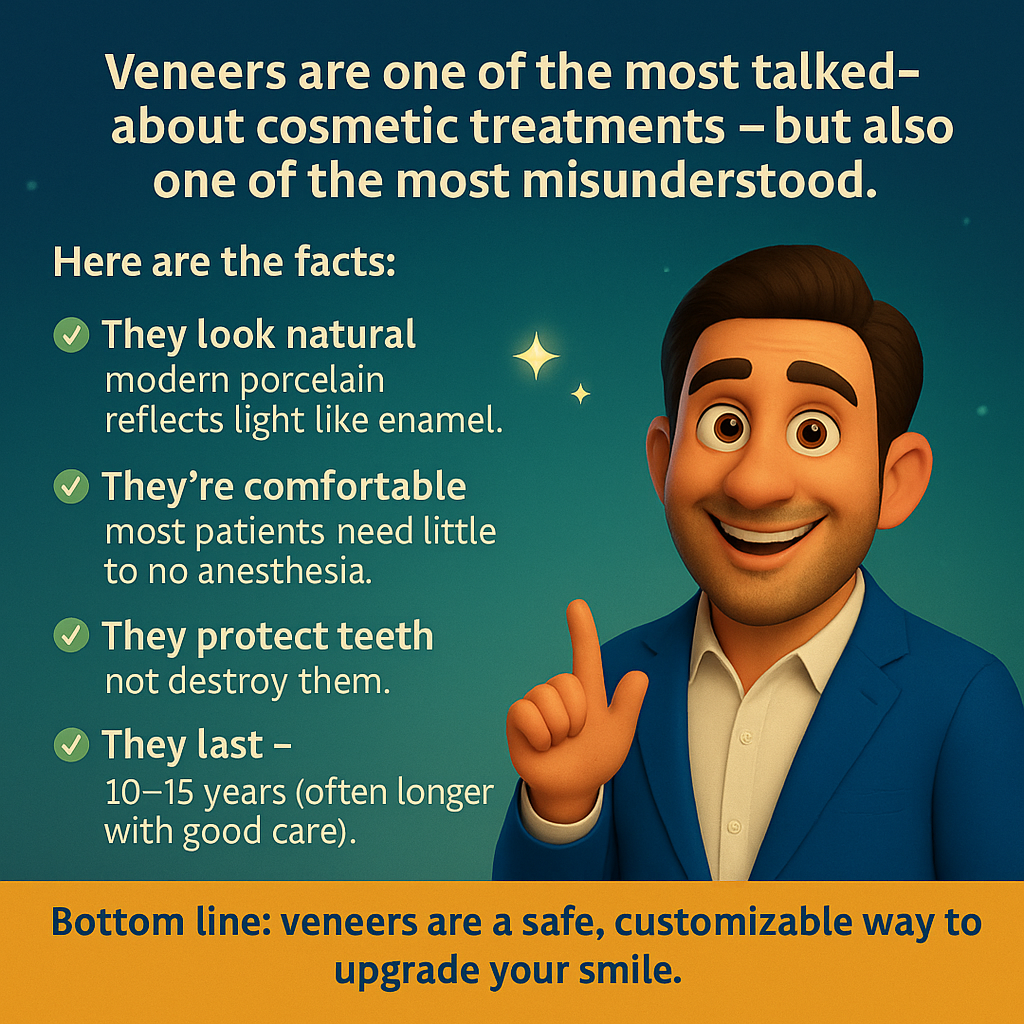
Last Updated: June 22, 2026 | Next Review: November 15, 2026 Written by: Dr. Charles Sutera, DMD, FAGD
Veneers look fake for specific clinical reasons, not aesthetic ones. The most common causes are over-preparation of the underlying tooth, the wrong porcelain material for the case, uniform shape across all teeth, and a design that ignores how the patient’s bite actually works. Color is almost never the real problem, even though patients usually point to whiteness first.
The cost of getting this wrong is significant. A patient who ends up with fake-looking porcelain veneers cannot simply remove them. Aggressive preparation has already altered the tooth structure underneath, sometimes irreversibly. Redoing the work means preparing already-prepared teeth, often into deeper material, and the second attempt carries more constraints than the first.
This post explains what actually causes veneers to look fake, what to ask before you start, and where most cosmetic dentistry quietly cuts corners. For the broader cosmetic decision framework, see our Cosmetic Dentistry Decisions guide.
Why do veneers look fake when the color seems right?
Color is rarely the cause. The cause is the absence of translucency, surface texture, and proportional variation. Although patients fixate on whiteness because it is the most visible variable, the eye reads “fake” from something deeper.
Natural enamel is semi-translucent. Light passes partway into the tooth before reflecting back, which gives teeth their characteristic depth and vitality. A well-made veneer, particularly in feldspathic porcelain, replicates this property. Light enters the outer layer of the porcelain before reflecting from deeper within. This is what separates a veneer that blends into the smile from one that sits on top of it.
In short, three optical properties drive the natural appearance: translucency at the incisal edge, micro-texture across the surface that scatters light, and slight color gradation from gum line to edge. Veneers that miss these properties look uniform, flat, and opaque. The shade is correct. However, the light behavior is wrong.
There is a structural reason this happens. When teeth are over-prepared, the dentist must use thicker, more opaque porcelain to hide the darker stump shade underneath. As a result, the opaque porcelain blocks light transmission. The result reads as fake even when the color is technically accurate.
What is the chiclet smile and how is it avoided?
The chiclet smile is a row of veneers identical in size, shape, and finish, which makes the smile look manufactured rather than grown. As a result, it is the single most common giveaway that someone has had cosmetic work.
Natural dentition follows a proportional hierarchy. The two central incisors are the widest teeth in the smile zone. Next to them, the lateral incisors are smaller, with slight variation in shape. The canines, by contrast, are pointed and shaped differently from the incisors. The visual effect is movement and character, not uniformity.
I tell patients this directly that if a dentist designs your veneers to be perfectly identical, they will look perfectly fake. Natural teeth aren’t identical, and a smile that looks real has to honor that. It has to be customized to you.
In our practice, veneer design follows intentional variation. Central incisors lead. Laterals sit slightly shorter and softer in shape. Canines retain their distinct anatomical character. Finally, surface texture varies across the teeth. The result is a smile that reads as a real human dentition, not a row of porcelain rectangles.
How should veneers match my face?
Veneers should follow facial proportions, not aesthetic trends. The patient’s face shape, lip line, and bite relationship determine the correct width, length, and shape of front teeth. A magazine photograph does not.
Three facial measurements drive veneer design. First, tooth length should fit the lip line so that 1 to 3 millimeters of the upper central incisors show at rest. Second, tooth width should follow the proportional relationship to the face. A square face supports wider teeth. An oval face supports narrower teeth. Third, tooth shape should match the patient’s existing facial characteristics rather than imposing a uniform aesthetic.
Technically excellent veneers can look completely wrong on the person wearing them. Teeth that look beautiful in a clinical photograph can overwhelm a smile in real life if they run too wide, too long, or too square for the patient’s face. Therefore, diagnostic planning should answer the question “what fits this person” before the dentist prepares anything.
How does my bite affect how veneers look?
Veneers that ignore the bite look stiff because the patient’s jaw is fighting against them. In other words, the aesthetic outcome cannot separate from the functional one.
The front teeth have specific contact patterns that guide jaw movement during chewing and speech. When the upper and lower teeth meet, the slopes of the front teeth steer the lower jaw forward and back. Dentists call these contacts anterior guidance, and they are how the jaw moves through its functional range without straining the joint or the muscles.
However, veneers that are too flat, too long, or positioned without regard for anterior guidance disrupt this system. The jaw muscles strain to compensate. The patient holds the mouth differently when speaking. Over time, the smile looks tight or unnatural even when the porcelain itself is well-made. The reason is mechanical, not aesthetic.
Speech is the other functional test. The lower lip touches the edges of the upper front teeth to produce the F and V sounds. Consequently, veneers that are too bulky or too long can disrupt this contact and change how the patient speaks. Nothing makes cosmetic dentistry more obvious than a change in speech.
This is where cosmetic dentistry intersects with TMJ. A cosmetic plan that doesn’t include bite analysis is incomplete. See How Is TMJ Diagnosed? for what that diagnostic process actually involves.

Can I try veneers before committing to permanent ones?
Yes, and you should insist on it. Specifically, the trial-veneer step is the single most effective protection against fake-looking outcomes, and it is the step most often skipped in high-volume cosmetic practices.
The standard protocol works in five steps:
-
Digital smile design and physical wax-up of the proposed new teeth, based on facial proportions and bite analysis
-
Mock-up or temporary veneers placed over the natural teeth or onto minimally-prepared teeth, mimicking the exact shape and thickness of the proposed final restorations
-
A minimum of one week wearing them through normal daily life. The patient eats, speaks, works, and sleeps in the temporaries
-
A return appointment to identify what works and what does not, including bite comfort, speech changes, and appearance under different lighting
-
Refinement of the design before the ceramist fabricates any permanent porcelain
This step is not optional in a properly designed case. Furthermore, adjustments made in temporaries remain reversible. Once the dentist bonds the final porcelain, adjustments are not.
A dentist who skips this step or treats it as inconvenient is a dentist to question. Same for a dentist who proceeds to permanent preparation in the same appointment as the consultation. The trial-veneer step takes time. It exists for a reason.
How many veneers do I actually need?
Almost always fewer than your marketing materials suggest. Most aesthetic concerns require 4 to 8 veneers on the upper front teeth. The 10, 12, and 16-veneer packages widely promoted on social media rarely meet clinical necessity, and they carry costs that patients aren’t told about up front.
How many of your teeth actually show?
The clinical question is how many teeth actually show when the patient smiles fully. For most patients, the answer is 6 to 10 upper teeth and 4 to 8 lower teeth visible in a full smile. The aesthetic question narrows further: of those visible teeth, how many have actual problems that need fixing, versus how many simply show.
My clinical position is that veneers belong on teeth with aesthetic problems, not on every tooth in the smile zone. Patients with one chipped central, two slightly discolored laterals, and otherwise healthy teeth do not need 10 veneers. They need 3 or 4, possibly fewer, with the surrounding teeth either left alone or matched through professional whitening.
Veneer count by clinical scenario
The table below shows the clinical reasoning behind veneer count decisions:
| Number of veneers | Clinical scenario | What it addresses |
|---|---|---|
| 2 to 4 | Localized aesthetic concern on specific teeth | Chipped centrals, single discolored tooth, isolated shape correction |
| 4 to 6 | Upper front teeth with multiple concerns | Shape, alignment, and color across the most-visible smile zone |
| 6 to 8 | Full upper smile zone for higher-display smiles | Patients whose smile shows premolars; broader aesthetic transformation |
| 10 to 16 | Comprehensive full-arch reconstruction | Rare. Reserved for structural bite cases, severe wear, or full-mouth rehabilitation |
Why marketing favors larger cases
There is a reason this isn’t how most cosmetic dentistry promotes itself. A 10-veneer case bills 2.5 times what a 4-veneer case bills. The social media before-and-after photos that drive most veneer demand showcase full-arch transformations because they look visually dramatic, not because they meet clinical need. Patients deserve to know that the smile they see in those photos often involved removing significantly more tooth structure than their actual concerns required.
I tell patients this in consultation. We discuss what specifically bothers them about their smile, identify the teeth that actually need restoration, and design the smallest intervention that achieves the aesthetic goal. Furthermore, fewer veneers means more preserved enamel, lower long-term maintenance, and a smile that ages more gracefully because it still includes natural tooth structure.
What porcelain material is best for natural-looking veneers?
The right material depends on the case. There is no universal best, and any practice that uses the same material for every veneer case is making a workflow decision, not a clinical one.
| Material | Translucency | Strength | Prep required | Best use case |
|---|---|---|---|---|
| Feldspathic porcelain | Highest | Lowest | Minimal (0.3 to 0.5 mm) | Upper front teeth with healthy enamel and high aesthetic demand |
| Lithium disilicate (e.max) | High | High | Moderate (0.5 to 0.7 mm) | Current standard for most veneer cases. Balances aesthetics and durability |
| Zirconia | Low (opaque) | Highest | Variable | Posterior teeth. Inappropriate for anterior veneers on aesthetic grounds |
Feldspathic porcelain offers the highest translucency and the most natural appearance. A ceramist hand-layers each veneer, which allows for precise customization of color, texture, and translucency. However, the trade-off is fragility. As a result, feldspathic is the right choice for highly visible cases where aesthetic demand is highest, particularly when the existing tooth structure is healthy and preparation can stay conservative.
Lithium disilicate (e.max) is the current standard for most veneer cases. It balances strength with translucency, holds up to typical bite forces, and is more predictable to fabricate. Although slightly more opaque than feldspathic porcelain, it still allows substantial light transmission. For most patients, this is the appropriate material.
Zirconia, by contrast, is opaque and the wrong material for anterior veneers on aesthetic grounds. It is strong but reads as flat and unnatural in the smile zone. It belongs in molars, not in the front of the mouth. A practice recommending zirconia for upper front veneers is solving the wrong problem.
In summary, material selection should follow the clinical case, the bite, and the patient’s aesthetic priorities, not the lab the practice happens to use.

Why does prep depth matter for natural appearance?
Prep depth determines whether the dentist bonds the veneer to enamel or to dentin. This single variable affects both how the veneer looks and how long it lasts.
A long-term clinical study found that porcelain laminate veneers bonded to dentin failed approximately 10 times more often than veneers bonded to enamel [1]. Specifically, veneers with preparations confined to enamel showed a 99 percent survival rate. Veneers with margins extending into dentin dropped to 94 percent.
The aesthetic consequence carries similar weight. Over-prepared teeth expose darker dentin underneath, which forces the dentist to use thicker, more opaque porcelain to mask the stump shade. Consequently, the thicker the porcelain, the less natural the optical result. This is the chain of causation behind most fake-looking veneer cases.
| Preparation depth | Enamel removed | Bonding surface | Failure rate (15-year) | Appropriate use |
|---|---|---|---|---|
| Minimal | 0.3 to 0.7 mm | Enamel only | 1% (99% survival) | Most aesthetic concerns. Default for healthy teeth |
| Moderate | 0.7 to 1.0 mm | Enamel, may approach dentin | 6% (94% survival) | Moderate shape or color changes |
| Aggressive | 1.0 to 1.5 mm | Extends into dentin | Approximately 10x higher than enamel-bonded | Structural problems, severe discoloration, significant alignment changes |
Source data: Gurel et al., 15-year survival study of porcelain laminate veneers [1], and clinical prep depth guidance [2].
Most cosmetic concerns fit within the minimal-prep range. By contrast, aggressive preparation should apply only to cases where structural problems, severe discoloration, or significant alignment changes require it. A dentist who prepares aggressively as a default produces weaker bonds and more opaque results than the case requires.
What should I ask my dentist before getting veneers?
Five questions reveal more about a veneer plan than the consultation itself.
1. Can I try temporary veneers for at least a week before any permanent preparation? If the answer hesitates, find another dentist. This step is non-negotiable in well-designed cases.
2. How much enamel will you remove from each tooth? Specific numbers matter. Anything beyond 0.7 to 1.0 millimeters on otherwise healthy teeth deserves explanation. “Just a little” is not an answer.
3. How does the plan account for my bite and jaw function? A cosmetic plan that doesn’t include bite analysis is incomplete. Expect to hear about anterior guidance, occlusal relationships, and how the veneers will sit relative to the lower teeth.
4. How many veneers do I actually need, and which teeth are necessary? If the answer is the full smile zone without specific clinical reasoning, ask why. The right number for many patients is 4 to 6, not 10 to 16.
5. Can I see physical or digital models of my teeth before and after? Still photos hide problems that show up when patients are speaking, laughing, or eating. Models of the mouth help to convey the aesthetics and function in ways that photos cannot.
Your next step
Veneers look fake when the clinical decisions behind them go wrong, not when the aesthetic taste goes wrong. Prep depth, material choice, design variation, bite integration, and veneer count all involve decisions that the dentist should make carefully and explain clearly before touching any tooth.
For a cosmetic consultation that begins with diagnostic planning and a trial-veneer protocol, and that takes a clear position on how many veneers you actually need, schedule a visit with our team at Aesthetic Smile Reconstruction. We serve Waltham, Newton, Brookline, Wellesley, Weston, Lexington, Cambridge, and Greater Boston.
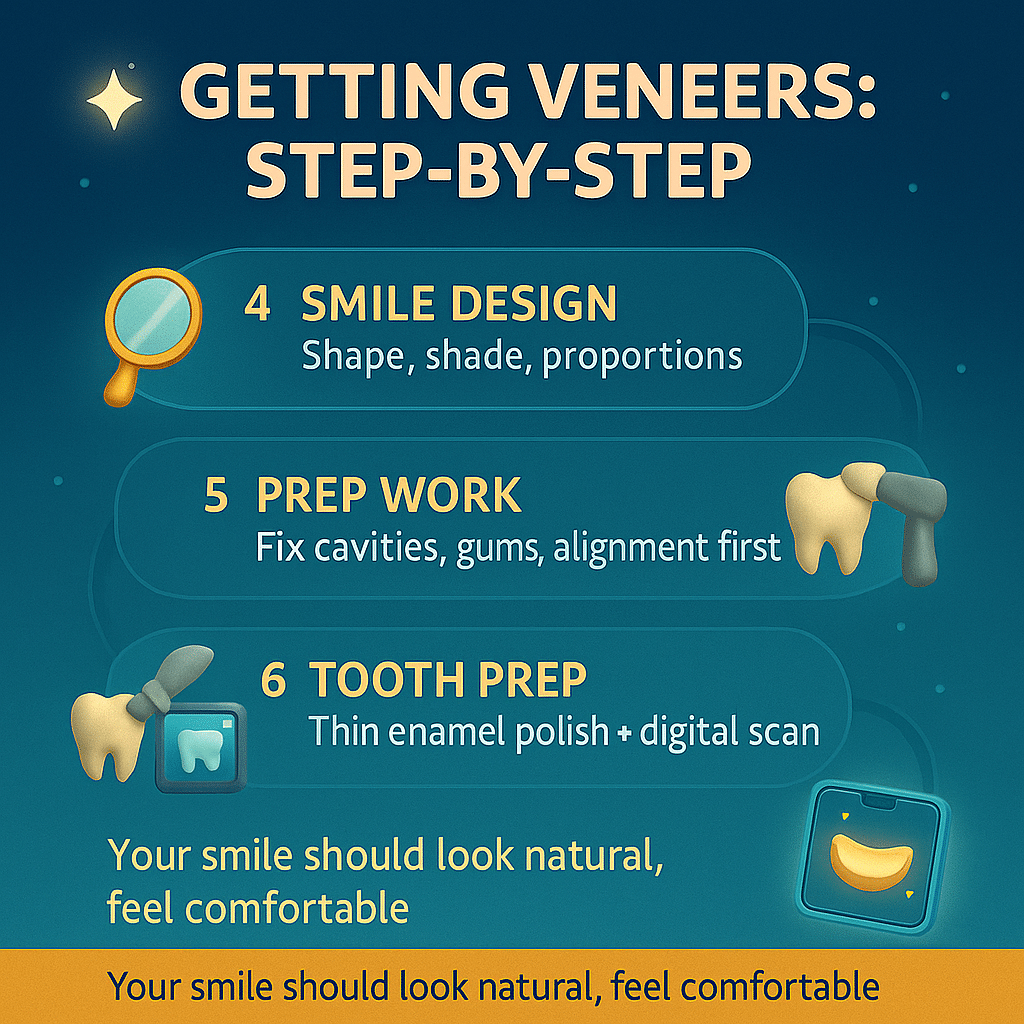
The veneer process is not a single appointment. It is a sequence of four clinical decisions that determine whether the result will look natural in five years or look obviously dental. Tooth preparation depth, material selection, bite analysis, and provisional review each happen before the final veneers are bonded. Patients who understand the sequence ask different questions during the consultation, and they get different results.
Schedule a consultation | Smile transformations | Cosmetic decisions guide | Dr. Sutera on LinkedIn
References
-
Gurel G, Sesma N, Calamita MA, Coachman C, Morimoto S. Influence of enamel preservation on failure rates of porcelain laminate veneers. International Journal of Periodontics and Restorative Dentistry. 2013. https://pubmed.ncbi.nlm.nih.gov/23342345/
-
Pro-Craft Dental Lab. E.max Porcelain Veneer Prepping Step-by-Step Guide. 2025. https://blog.pro-craft.com/e.max-porcelain-veneer-prepping-step-by-step-guide
-
McLaren EA. Porcelain Veneer Preparations: To Prep or Not to Prep. Inside Dentistry. https://edmclaren.com/store/1/Articles/Porcelain_Veneer_Preparations.pdf
Medical disclaimer. This article provides general educational information and reflects published clinical standards. Individual needs and outcomes vary. A complete examination is required for personalized recommendations.
