

Spend ten minutes reading about jaw pain online and you’ll find plenty of confident advice. A lot of it is wrong. These are the TMJ myths I hear most often from patients, and what the evidence actually says.
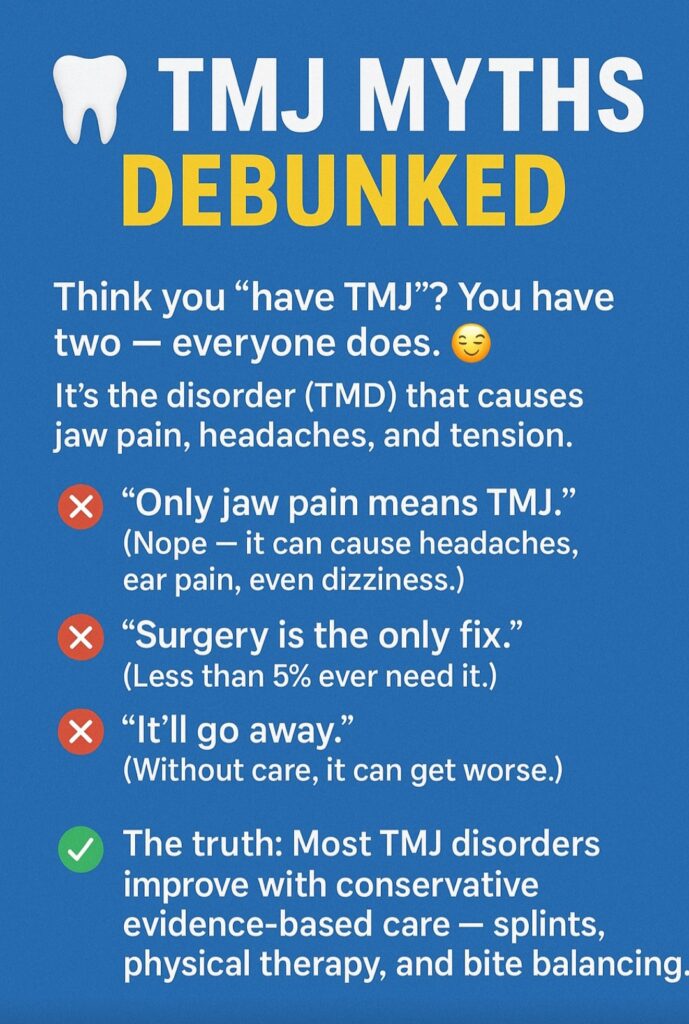
Is it correct to say “I have TMJ”?
Not quite. TMJ stands for temporomandibular joint, the hinge that connects your lower jaw to your skull. Everyone has two of them.
The condition that causes pain and dysfunction is temporomandibular disorder, or TMD. It isn’t one disease. It’s an umbrella term for dozens of conditions affecting the joints and the muscles around them. That matters, because the right treatment depends on which one you have.
Is jaw pain the only symptom of TMD?
No. Jaw pain and clicking are the classic signs, but the jaw muscles and nerves connect to much of the head and neck, so symptoms can show up elsewhere. Patients are often surprised these are related:
- Headaches and migraines. Jaw clenching is a common trigger.
- Earaches, ringing in the ears and dizziness. The joint sits just in front of the ear.
- Neck, shoulder and back pain. A strained jaw can change your posture.
- Facial pain and tooth sensitivity with no obvious dental cause.
Is surgery the only real fix for TMD?
No, and this myth scares a lot of people. Surgery is a last resort for a small share of severe cases, and the National Institutes of Health recommends starting with conservative, step-by-step care.
Most patients do well without it. Conservative options include custom oral appliances, physical therapy and jaw exercises, stress management and, for muscle pain, treatments like Botox for TMJ. If you want to know when TMJ surgery is actually needed, I’ve written about that separately.
Does chewing gum cause TMD?
Not on its own. Chewing gum can aggravate a jaw that’s already strained, and poor oral hygiene causes plenty of problems, but neither is a root cause of TMD. Research points to factors like these:
- Bruxism, meaning clenching or grinding
- A misaligned bite
- Arthritis in the joint
- Injury to the jaw
- Stress
Is TMD rare?
Far from it. The National Institute of Dental and Craniofacial Research estimates TMD affects roughly 5 to 12% of people. Thinking it’s rare keeps many of them from getting help.
Does jaw clicking always need treatment?
No. A click without pain or trouble moving your jaw often needs nothing more than monitoring. What matters is pain or loss of function, not the sound alone.
Will TMD go away on its own?
Sometimes mild flare-ups settle. But assuming persistent symptoms will vanish is risky. Left alone, TMD can lead to chronic pain, worn or damaged teeth and poor sleep.
If you’re tired of conflicting advice about your jaw, the fastest way past it is a proper diagnosis. Come see me and we’ll find out what’s really going on.
This article is general educational information and not a substitute for a dental evaluation. Individual needs vary. All sedation is provided under a Massachusetts Board sedation permit with continuous monitoring.
Not close to Waltham? Patients from Brookline, Cambridge, Somerville, Newton, Wellesley, Concord, Lexington and Waltham can send photos and records before they travel, so Dr. Charles Sutera can review them first. Find us at 75 3rd Ave, Waltham, MA 02451, call (781) 487-1111, or read how TMJ evaluation and treatment work.
